How Your Body Language Is Shaping Your Confidence (Whether You Know It or Not)
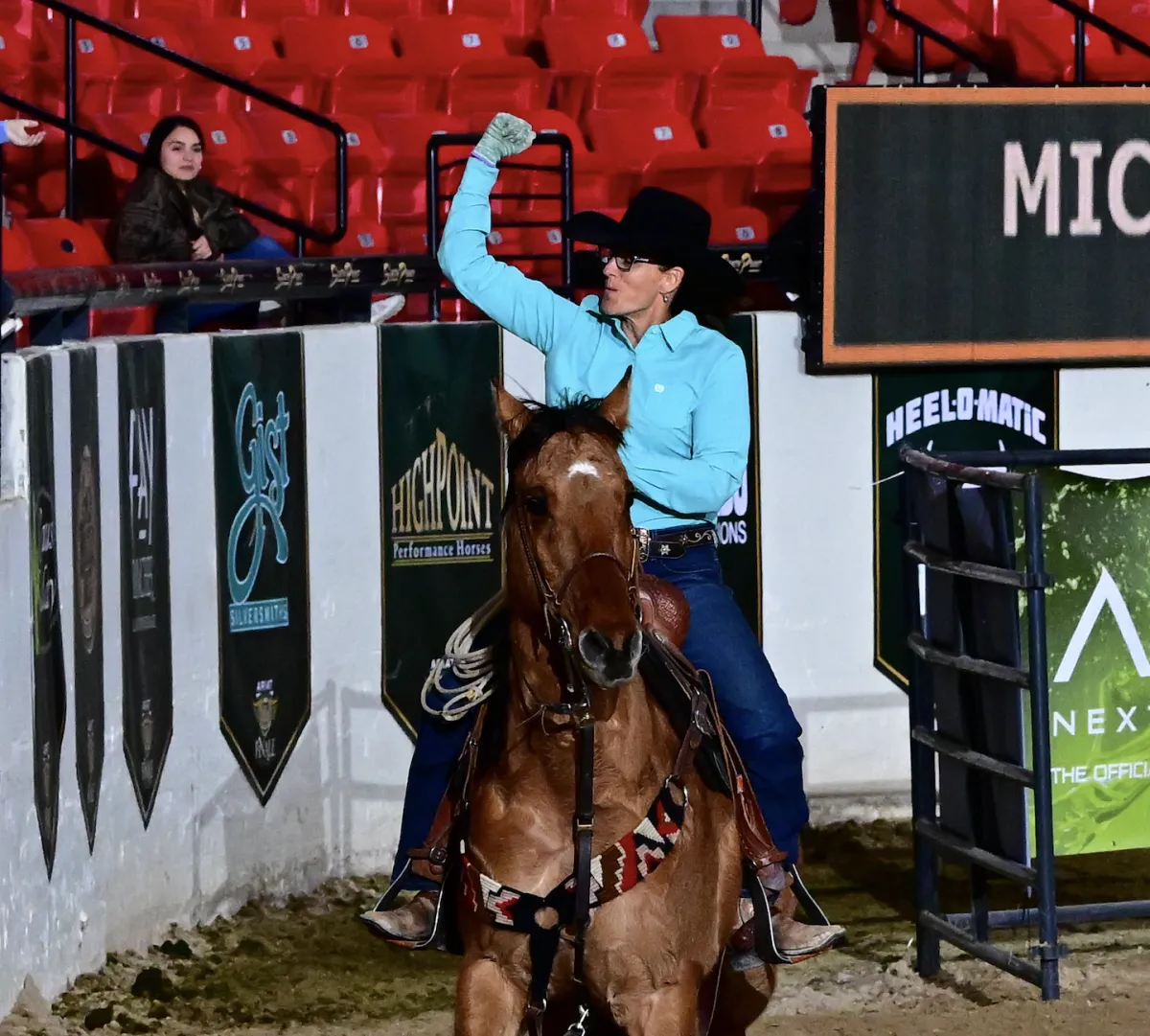
There was a woman I used to see at ropings that made quite an impression on me. I don't even remember her name, but I remember exactly how she carried herself. Chin up, shoulders back, moving through the arena like she belonged there — like winning was just a matter of time. She hadn't even roped yet but I could tell she was one of the best.
I recall watching her with a complicated mix of admiration and envy. What must it feel like, I wondered, to just have that? To walk around with that kind of quiet confidence like it was the most natural thing in the world?
What I didn't understand at the time — and what took me years to figure out — was that she might not have been feeling it any more than I was. She might have been doing exactly what I eventually learned to do: choosing to carry herself that way on purpose.
In fact, one of my earliest tricks when I wasn't feeling confident was to pick a competitor I admired and ask myself — how would she walk right now? How would she stand? How would she move through this arena? And then I'd do my best to match it. It felt a little silly at first. But something shifted when I did it. My brain started receiving a different signal. And the research, as it turns out, backs that up completely.
Because here's what most people don't know: your body language doesn't just reflect your confidence. It creates it.
THE TWO-WAY CONVERSATION BETWEEN YOUR BODY AND YOUR BRAIN
Most of us understand the basics of the mind-body connection in one direction. We feel nervous, our hands shake. We feel defeated, our shoulders drop. Emotion drives posture. That part makes intuitive sense.
But what the research is showing us is that the reverse is equally true — and equally powerful. Your posture sends signals back to your brain. The way you hold yourself right now is communicating something to your nervous system about who you are and how safe you are. And your brain, which is always scanning for data, is listening.
This means that how you carry yourself at the grocery store, in the parking lot, sitting at your desk, walking to the arena — all of it is either feeding your brain a message of confidence and capability, or one of smallness and uncertainty.
WHAT AMY CUDDY'S RESEARCH REVEALED
Harvard social psychologist Amy Cuddy and her team wanted to know whether intentional body language could actually change brain chemistry — not just how someone felt, but what was measurably happening inside their body.
The answer was yes.
Participants who held expansive, open postures — what Cuddy called power poses — for just two minutes showed measurable increases in testosterone, associated with confidence and assertiveness, and measurable decreases in cortisol, the stress hormone. The participants who spent those same two minutes in low power positions showed the opposite pattern.
Two minutes of intentional posture changed the hormonal environment inside the body.
In a follow-up study, participants prepared for a high-pressure job interview. One group spent two minutes in power poses beforehand. The other group spent two minutes in low power poses. The evaluators — who had no idea which group anyone was in — consistently rated the power posers as more confident, more compelling, and more hireable. Not just because of their answers. Because of the presence they walked in with.
Cuddy's reframe of the familiar saying says it all: it's not fake it till you make it. It's fake it till you become it. Because with enough repetition, body language stops being something you're performing and starts being who you are.
MOTION CREATES EMOTION
Tony Robbins has built much of his work around three words: motion creates emotion. The principle is simple and the application is immediate — you can shift your emotional state faster through your body than almost any other method.
And he takes this very, very seriously. If you've ever seen him work with a crowd of thousands of people, one of the first things he does is get everyone moving. Jumping. Clapping. Dancing.
The first couple of times I watched him, I didn’t like this part, I thought it was all unnecessary hype. But, when he explained that you can move your way to a peak state faster thank you can think your way there, I decided to give it a go. And, although I started off feeling phony and stupid, by the end of it I noticed I was laughing and actually felt more awake and alive than when I started.
Think about what a low state looks like physically. Rounded shoulders. Caved chest. Shallow breathing. Slow, heavy movement. Eyes down. Every signal broadcasting to your brain: I am not okay.
Now think about a high state. Upright posture. Open chest. Deep, intentional breathing. Energy in the movement. Eyes forward. The brain receives an entirely different message.
The slump spiral is real. A difficult moment leads to collapsed posture, which deepens the feeling of defeat, which leads to more collapsed posture — and before long you're in a hole that feels much bigger than the original problem. But the reverse is also true. One intentional shift — chin up, shoulders back, one deep breath — can interrupt that spiral before it takes hold.
You are not stuck in whatever emotional state you walk into a room with. You have the ability to change it through your body, right now, in seconds.
THE DOUBLE PUNCH: BODY LANGUAGE PLUS POWER STATEMENTS
If you've been listening to Cowgirl Up for a while, you know that power statements are a cornerstone of this work. Short, first-person, present-tense declarations of who you are and how you show up — repeated consistently until your subconscious accepts them as truth.
Here's what happens when you pair them with big body language.
When you speak a power statement while simultaneously holding an open, expansive posture, you're hitting your nervous system from two directions at once. Your words are feeding your subconscious a message of strength and capability. Your body is sending your brain the physical confirmation that those words are true. They reinforce each other. They amplify each other.
If you say I always carry myself with big body language while slumped on the couch, your brain gets mixed signals. The words say one thing, the body says another, and the subconscious isn't fully buying it. But if you stand tall, plant your feet, roll your shoulders back, lift your chin, and then say those words — everything is aligned. Your brain receives a unified message, and that's where the real reprogramming begins.
This is the double punch — and it's significantly more powerful than either tool used alone. I created a strategy specifically to harness this dynamic duo, called 'Champ Talk,' that you can check out here: https://mentalgame101.com/champtalk
HOW TO BUILD THIS INTO YOUR DAILY LIFE
You don't need a dramatic routine overhaul to make this work. Start with thirty seconds. Before your feet hit the floor in the morning, sit up tall and say your power statement out loud with your body fully engaged. Before you walk into any room where you want to show up well, take two minutes. Before a high-pressure moment in your sport — use it there too.
The goal is to make the pairing — big body language plus power statement — a consistent daily practice. Because as we talked about with the 66-day research, repetition is what builds new neural pathways. Over time, standing tall starts to automatically trigger the thought. And the thought starts to automatically trigger the posture. They become one thing.
And that one thing is confidence. Not the kind that depends on your last result. The kind you build on purpose, one thirty-second rep at a time.
You were made to take up space. Start acting like it.
⭐️⭐️⭐️
Ready to go deeper? Listen to the Cowgirl Up podcast on Spotify, Apple Podcasts, or wherever you get your podcasts — new episodes drop Monday through Friday.
Interested in building a complete mental skills toolkit with personalized coaching support? Schedule a free discovery call at mentalgame101.com.
⭐️⭐️⭐️
ABOUT THE AUTHOR
Laurie Blickenstaff is a Certified Mental Performance Coach, competitive team roper, and founder of Mental Game 101. She hosts the Cowgirl Up daily mindset podcast and works one-on-one with women competitors in western horse sports who are ready to close the gap between their physical preparation and their mental game. Learn more at mentalgame101.com.
Mental performance training is NOT intended as, nor is it a substitute for, mental health care.
